
A sintered filter is a porous component formed by compacting metal powders and sintering them below their melting point, bonding the particles while retaining an interconnected pore network. This porous structure permits controlled filtration, gas diffusion, and flow regulation. As a result, sintered filters are widely applied in automotive filtration systems, water treatment, chemical processing, and fluid handling equipment. 
If you want to learn more about sinter filters, this blog has these parts you may like to read:
Characteristics of Different Sintered Materials
The sign is used to represent different degrees.
| Sintered Material | Cost | Corrosion Resistance | Durability | Heat Resistance | Other Features |
| Sintered Bronze Filter | ** | ** | ** | ** | Good Thermal Conductivity |
| Sintered Plastic Filter | * | *** | * | * | Lightweight, Easy Production |
| Sintered Stainless Steel Filter | *** | *** | **** | **** | Heavyweight |
| Sintered Titanium Filter | ***** | ***** | **** | **** | Best Performance in Harsh Environments |
| Sintered Glass Filter (Fritted Glass Filter) | ** | **** | ** | ** | Brittle |
| Sintered Ceramic Filter | **** | **** | *** | **** | Brittle |
Main Features of Sintered Filters
Filtration Ratings
The filtration rating is also called filtration accuracy, which refers to the ability to remove specific particles from the fluid. It can be measured by the size of particles that the sintered porous filter trapped.
The filtration rating can be expressed in terms of microns (µm), which represents the particle sizes. Typically, the general filtration rating of sintered metal filters ranges from 0.5 to 100 microns (µm).
Among those sintered filters mentioned above, those used in special environments could offer filtration ratings of a higher level. For instance, the filtration rating of sintered plastic filters can reach 0.2 micron when used in pharmaceutical, biotech, or microelectronics.
Working Temperature
Each sintered material has a specific working temperature range.
Some could be hard to stand at high temperatures like sintered plastic filters could work at 150°C approximately at most, or thermal degradation may occur.
Some have better heat resistance as sintered ceramic elements’ working temperature can be up to 1000°C.
If the operating temperature is too high that filters can’t withstand, the pores gap will change, affecting the filtration efficiency. On the contrary, when the operating temperature goes too low, the whole structure may be brittle, and easy to be damaged.
You may want to know the recommended temperatures of each sintered material:
| Types of Sintered Filter | Recommended Temperature |
| Sintered Bronze | -50°C to +150°C |
| Sintered Plastic | -20°C to +80°C |
| Sintered Stainless Steel | Lower than 600°C |
| Sintered Titanium | Lower than 300°C |
| Sintered Glass (Fritted Glass) | Lower than 100°C |
| Sintered Ceramic | Lower than 800°C |
You need to consider the operating temperature range and the specific requirements of your application. Only in this way can you ensure consistent performance.
Steps of Producing Sinter Filters
Sintered metal filters are primarily produced using powder metallurgy, through powder mixing, powder compaction, sintering, and secondary operations.
Mixing and Blending in Powder Metallurgy (PM)
Depending on your application, you can choose common types of powder materials such as metal powders or polymer powders.
In addition, you can also mix the powders to achieve specific properties.
Powder Stamping
With intense pressure, powder materials are compacted in molds that have variable shapes (sintered disc, sintered plate, sintered tube, etc.). However, the whole porous structure remains relatively loose.
Sintering Process in Powder Metallurgy
The key step of manufacturing is the sintering process in powder metallurgy, which determines the properties of sintered parts.
Filter materials will be heated to a temperature lower than its melting point, bonding the powders together, while keeping physical properties.
Secondary Operations in PM
After the filter elements cool down to room temperature, check the quality according to your requirements.
If there are some deviations, then reprocess (cutting, polishing, or machining). Finally, clean the sinter filters to remove contaminants.
Advantages of Sintered Materials
Why choose sinter filters? Here are some advantages that ensure their reliable filtration performance.
Corrosion Resistance
Sintered filters are made from materials such as bronze, stainless steel, nickel-based alloys, and titanium alloys, offering excellent corrosion resistance. In addition to sintered metal filters, sintered ceramic filters also demonstrate outstanding performance in corrosive environments. 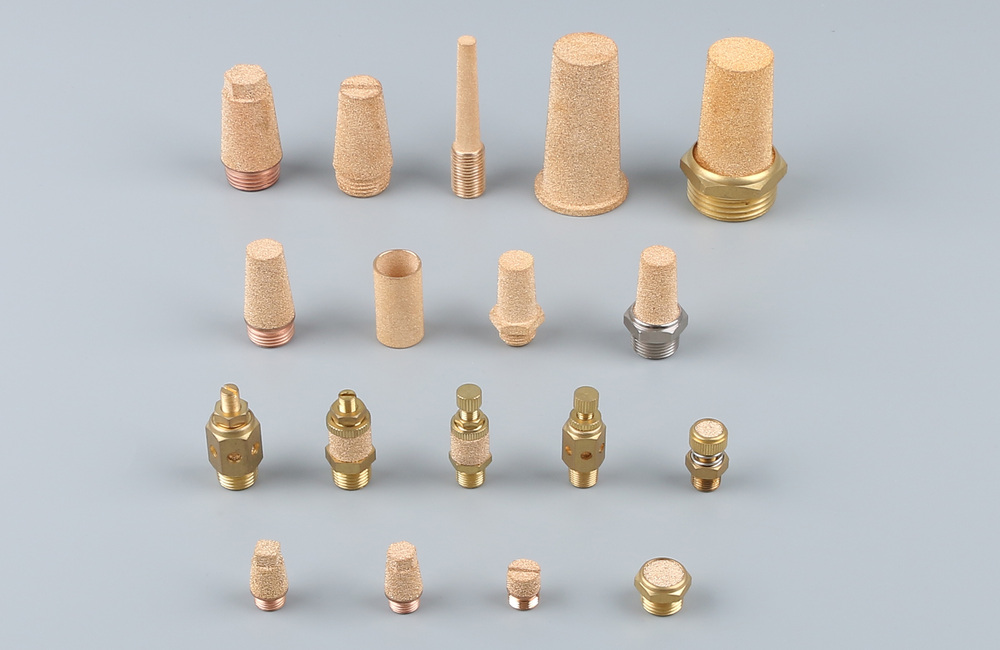
Enhanced Purification
You can choose sintered filters of specific filtration accuracy to keep the filtration efficiency at a high level.
In HVAC (Heating, Ventilation, and Air Conditioning) systems, sintered metal filters with filtration ratings ranging from 5 to 20 microns are commonly chosen to protect HVAC equipment from contaminants. These filters can effectively capture various particles in the air.
What’s more, the material that does not react chemically with the fluid can avoid the entry of new substances. In all, the filtered results will be more accurate.
Pressure Sustaining
If there are pressure fluctuations during the filtration, the entire system will be affected to some degree.
Due to their mechanical strength, sintered metal filters are good at maintaining fluid pressure to ensure stable system operation.
Robust Durability
Sintered filters have better durability and longer service life in extreme temperatures. With proper maintenance, these sintered parts can be used for many years, often ranging from 3 to 10 years or even longer in some cases, which can reduce the number of replacements, thereby saving costs.
Potential Disadvantages of Sintered Parts
Though many advantages are provided, they still have some potential drawbacks that you need to notice:
Cost
The choice of materials mainly determined the cost of sinter filters. High-performance materials can be more expensive.
Also, the complexion of the manufacturing process adds to the cost.
In March 2024, the price of stainless steel mixed powder (SS-303L) with a diameter of 100 microns in China is about $590,000 /ton.
Clogging
As time goes by, small pores may become clogged with particles, reducing the filtration efficiency. In other words, they need regular cleaning and maintenance.
Cleaning may require specialized equipment and procedures. Some sintered elements used in chemical environments can be more challenging to clean thoroughly. This means it costs not only money but also extra time.
Material Limitations
Raw materials for making sintered filter elements are not of a wide range.
What’s more, one material cannot be applied to all situations. So for special environments, the choice will always be limited.
Production Time
Compared to other filters, the manufacturing time of sintered filters is long. For different sintered materials, the production time of some sintered metals may be longer.
For example, if the production time of a batch of sintered bronze filters is 1 day, the same number of sintered stainless steel filters could take a week or more.
So if buyers need a great amount of sintered filters, it’s better to place the order in advance.
Sintered Filter Working Principle
For Oil or Water Treatment
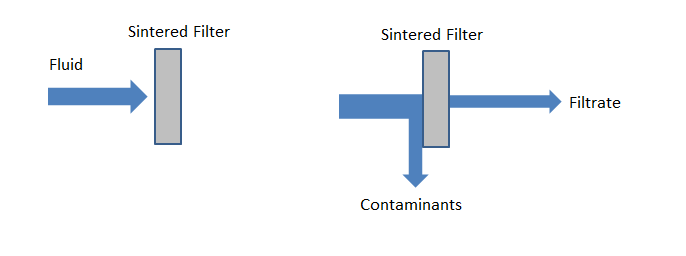
Sintered porous filters are widely used in fluid filtration or liquid filtration, allowing fluid (liquid) to pass through the pores.
When flowing through the filter, particles larger than the pore sizes are trapped, thus the fluid is purified.
For Noise Reduction and Soundproofing

When the sound waves go into the filter, they will cause the air in the filter to vibrate. This movement creates friction and resistance, which turns the energy of sound into heat, reducing the amplitude of the sound waves.
Industry Applications of Porous Sintered Filters
Due to plenty of distinct advantages, sintered filters have a wide range of applications.
Food and Beverage Industry
For beverage production, you can use filter layers to filter pulp and suspended solids to ensure the clarity of the liquid.
Meanwhile, purified water for food processing can also be obtained by water treatment.
Chemical Industry
In chemical processing industries, these sintered filters can be used in corrosive environments, like sintered glass filters used in laboratories.
Some chemical waste may be harmful to the environment, which requires some filtration of these substances.
Electric Industry
You can also use sintered filter elements to remove impurities in the operating conditions. It can maintain the normal operation of the machine and extend the service life.
(For instance, sintered bronze filter discs are used in vents of electric motors to prevent the entry of dust, moisture, and other contaminants while allowing air exchange. This helps to maintain the internal environment of the motor.)
Petroleum Industry
Porous metal filters are used to remove contaminants from fuels and lubricants, ensuring smooth operation and prolonging the life of machinery.
(Sintered stainless steel filter tubes are used to remove contaminants from crude oil during production and transportation processes. These metal filters help to keep product quality, protect equipment, and prevent pipeline fouling.)
Maintenance of Sintered Filter Elements
Regular Inspection
Visual inspection is to check for signs of damage and decide whether it needs replacement.
Then perform a short filtering action, and test the filtered fluid to see whether the filter layer is clogged.
Sintered Parts Cleaning
After a period of use, there may be some residual dirt on the filter layers, which will cause blockage if not cleaned in time.
-
- A common method is ultrasonic cleaning, which can effectively remove fine particulates and contaminants.
-
- If an element’s surface has some chemicals that are difficult to wash off, using chemical solutions that can dissolve the contaminants is the easiest way to clean up.
BLUE a specialized sintered filter manufacturer in China. We supply filters in bronze, stainless steel, nickel, titanium, and plastic, available as plates, discs, and tubes. Our products serve applications such as filtration, breather vents, mufflers, and gas diffusion with reliable and consistent performance. 
FAQ
After a basic introduction, you may still have some of these questions:
What affects the filtration ratings?
The uniform pore size is the key point to the precision, which affects the final filtration efficiency. What’s more, the sintered powder sizes could make a difference.
Why Sintering is Important?
As said above, the numbers and sizes of pores distributed on the filters directly determine the filtration efficiency. It is the temperature and time of sintering that control these factors, that’s why sintering does matter.
As delineated by Wikipedia, this method is integral to the fabrication processes employed across various substances, including metals, ceramics, plastics, and more.
Can sintered metal filters be used for sterile filtration in pharmaceutical applications?
Yes, of course they can.
Filtration in the pharmaceutical industry usually involves liquid filtration and gas filtration, which stays in line with the scope of the application of sintered metal filters.
(For example, you can use sintered metal filters in the final filtration, removing residual particles or microorganisms before packaging.)
What filtration rating is a paper coffee filter?
Generally, paper coffee filters have average pore sizes ranging from 10 to 20 microns, which vary depending on the material type and brand of the coffee filter.
If you are referring to the espresso puck screens, especially those made from sintered stainless steel, the filtration rating is around 150 microns.
Can porous metal filters be customized?
Yes.
According to your application and requirements, you can customize specific characteristics (pore sizes, powder sizes, sintered materials, shapes, and flow rate) of your porous metal filters.
In addition, the operating environment needs to be considered as well.
 EN
 DE
 ES
 PT
 FR
 RU